
Organic
Relates to defined organic ingredient, production and certification criteria under the chosen standard.
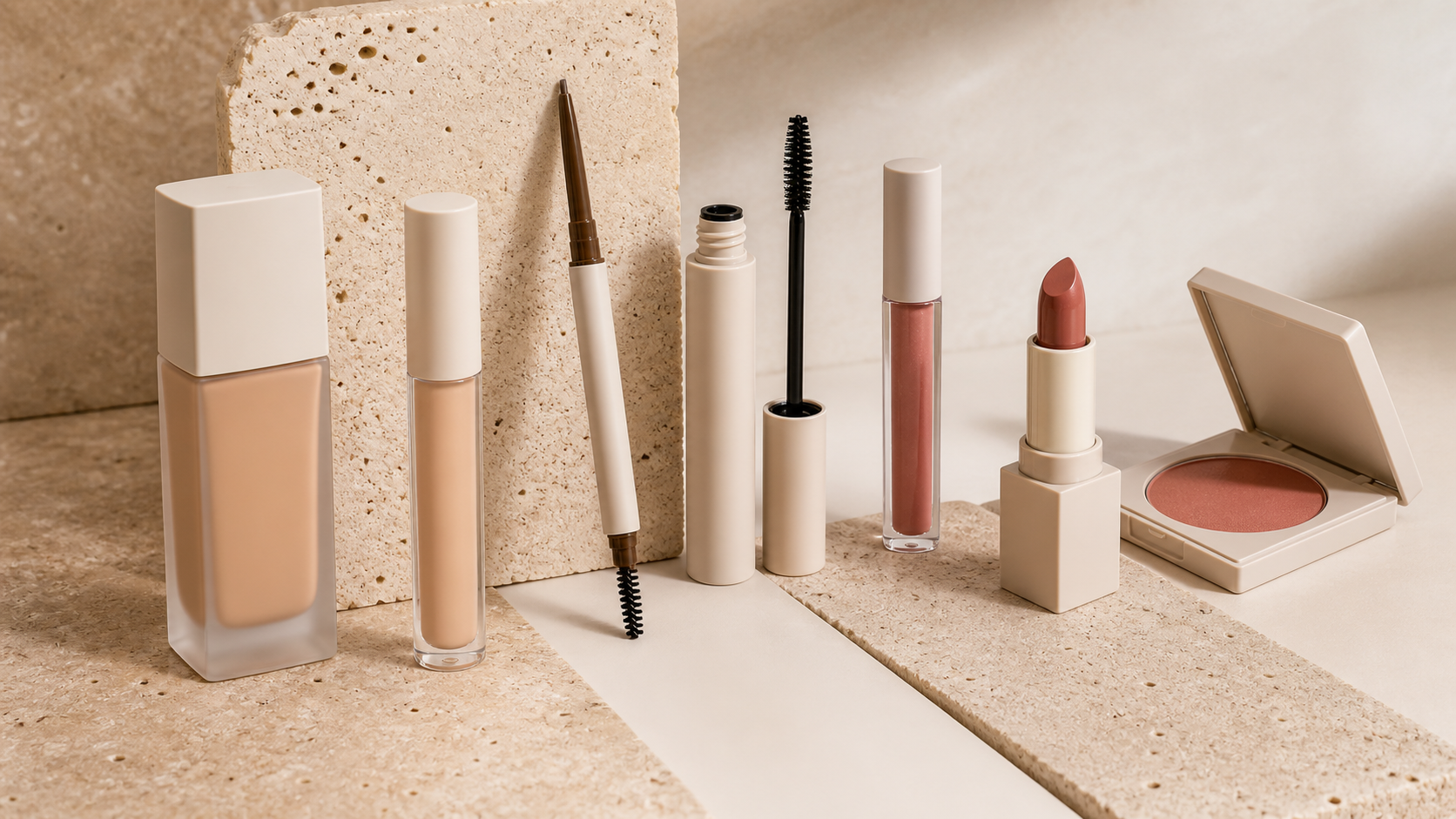
COLOR COSMETICS MANUFACTURING GUIDE
Beauty brands often use organic, natural and vegan interchangeably, but they describe different product and certification concepts. Define the claim your brand actually needs before requesting samples or quotations.
Relates to defined organic ingredient, production and certification criteria under the chosen standard.
May refer to ingredient origin or a technical framework; it is not automatically the same as organic.
Focuses on animal-derived ingredients and applicable vegan criteria. It does not mean organic.
Organic ≠ Natural ≠ Vegan
UNDERSTAND THE BRIEF
The meaning depends on the target market, certification scheme, ingredient categories, formula, processing controls and the claim shown on pack.
Eligible inputs need evidence consistent with the selected scheme.
The calculation basis depends on ingredient categories and the relevant standard.
Supplier records and material flow need to support the finished-product claim.
Processing, storage and segregation requirements can form part of certification.
Certification and audit evidence are distinct from a standard manufacturer statement.
Claims must match the standard, market and evidence available for the finished product.
STANDARDS IN CONTEXT
COSMOS V4.2 has applied since 1 September 2025. It treats organic requirements by ingredient category; its Technical Guide explains that the 95% figure applies to physically processed agro-ingredients (PPAI), not simply to every finished cosmetic. Product thresholds, exceptions, manufacturing controls and certification all need review.
FDA does not define organic for cosmetics. USDA’s National Organic Program regulates organic agricultural claims; a cosmetic may be eligible only if applicable NOP production, handling, processing and labelling requirements are met. USDA organic status does not replace FDA cosmetic safety and labelling requirements.
ISO 16128 provides technical definitions and calculation approaches for natural, natural-origin, organic and organic-origin indices. It is not product certification, a safety standard or a labelling/claims rule.
Ingredient origin alone does not determine safety. Safety depends on the ingredient, concentration, finished formula and intended use. Neither organic nor synthetic should be used as a shortcut for a safety conclusion.
A DIFFERENT CLAIM ROUTE
Focuses on animal-derived ingredients and, where relevant, the criteria of a chosen vegan standard. Vegan color cosmetics may use synthetic or mineral cosmetic ingredients and do not need to be organically farmed.
A product can be vegan without being organic.
Focuses on organic-origin agricultural ingredients and the requirements of a certification scheme. Organic status does not automatically establish a vegan claim.
An organic ingredient claim does not automatically establish a vegan claim.
For eligible formulas, SindeBella may provide a manufacturer declaration based on the final formula and available raw-material supplier documentation confirming that no intentionally added animal-derived ingredients are used in the formula. It is not a third-party certification mark.
Certification bodies apply their own rules and evidence requirements. The Vegan Society Vegan Trademark, for example, addresses animal ingredients, animal testing under its standard and cross-contamination minimisation. A manufacturer declaration and third-party certification serve different purposes.
COLOR COSMETICS REALITY
SindeBella does not currently offer COSMOS ORGANIC certification or USDA NOP-certified organic production.
There is no universal regulatory MOQ for certified organic cosmetics. Certification requirement is not the same as a regulatory MOQ, and a manufacturer’s commercial MOQ is not certification law.
Certified ingredient sourcing, raw-material purchasing quantities, traceability, production controls, documentation, certification or audit costs, formula qualification, testing and production setup can make very small custom projects impractical. Brands requiring certified organic production should first define the intended standard and work with a manufacturer whose facility, ingredients and certification system support it.
SUPPLIER DUE DILIGENCE
A supplier saying “organic makeup available” does not identify the certification scheme, the certified part of the supply chain, or whether the quoted MOQ applies to an existing certified formula or new development. Confirm the scope before paying for samples.
Ask whether the supplier means COSMOS ORGANIC, USDA NOP where applicable, or another named programme.
Confirm whether certification covers the site and relevant production activity, not only an ingredient supplier.
Check the named entity, site, scope, issue date and expiry date.
An ingredient certificate does not by itself establish a certified finished cosmetic.
Ask whether the quote is for an existing eligible formula or a new shade, format or formula-development project.
The starting point can differ between an existing route and a new development brief.
This prevents a headline quantity being mistaken for the total range commitment.
Request a split between product cost, development, testing, certification activity and ongoing fees.
Ask how supplier documents, incoming materials and formula records are linked for the finished product.
Do not assume a brand may place a mark on packaging without the applicable approval process.
For color cosmetics, performance ingredients can change feasibility and should be reviewed against the selected route.
Ask the programme owner or certified supplier rather than making broad assumptions.
The supplier should explain its product-specific testing and release process without implying a universal package.
Clarify responsibility among the brand, manufacturer, certification body where relevant and target-market regulatory roles.
These points do not automatically mean a supplier is unsuitable; they are reasons to ask for clarification before committing to samples or production.
DEFINE THE RIGHT REQUEST
Define the exact certification scheme first, then verify a certified route that supports the facility, formula and claim.
Natural or natural-origin formulation may be the actual brief. It is not automatically certified organic.
A vegan formulation direction may be relevant. Confirm whether you need a manufacturer declaration or third-party certification.
Define the specific, measurable claims rather than assuming organic certification is required.
Certified-organic fully custom development is not part of SindeBella’s current programme at this quantity. Another route may better meet the actual brand goal.
Share your target market, product type, documentation need, quantity, shade, finish and packaging direction.
Ingredient-origin information, a supplier certificate or an individual component statement does not automatically prove a finished-product marketing claim. Under EU cosmetic-claims common criteria, claims should be supported by adequate and verifiable evidence.
COMMON QUESTIONS
Organic makeup is not one universal legal category. Its meaning depends on the certification scheme or claim framework and evidence for the finished product.
No. Natural, natural-origin and organic may be evaluated under different definitions. Natural is not automatically certified organic.
No. Vegan and organic address different criteria. A vegan cosmetic can use mineral or synthetic ingredients.
Yes. Vegan relates to intentionally added animal-derived ingredients and applicable vegan criteria; it is separate from organic certification.
No. A finished-product route may involve formula eligibility, traceability, processing, documentation, labelling and scheme requirements.
COSMOS is a private standard used by participating certification bodies. Check its current criteria with the relevant body for a specific route.
Do not rely on a headline percentage. Calculation rules and claim conditions need scheme-specific review.
USDA’s National Organic Program governs organic agricultural claims. The applicable cosmetics route needs case-by-case review.
No. FDA states it does not define organic for cosmetics, and ingredient source alone does not determine safety.
No. Safety depends on the ingredient, concentration, finished formula and intended use, not simply source.
ISO 16128 provides technical definitions and calculation approaches for natural and organic ingredients. It is not a consumer certification.
No. It does not address certification, product communication, safety or regulatory compliance.
No. A manufacturer declaration relies on final-formula and supplier documents. A certification body applies its own evidence review and trademark rules.
For eligible formulas, SindeBella can support vegan formula directions and manufacturer documentation where appropriate, based on the final formula and available supplier documents.
No. Certified organic makeup manufacturing is not currently part of SindeBella’s production programme.
Not under SindeBella’s current manufacturing programme. For a small launch, ask about eligible vegan or natural-origin directions that do not require certified organic production.
There is no universal regulatory MOQ. Certification requirements are not regulatory MOQ rules, but sourcing, documentation, production setup and batch economics can make small custom projects difficult.
Ask which scheme applies, what the facility certificate covers, whether the finished formula is eligible, how MOQ is calculated, which fees apply and who approves final label or logo use.
No. These are different concepts. Any animal-testing or certification claim needs separate product-specific evidence and target-market review.
Clarify whether the goal is vegan, no intentionally added animal-derived ingredients, natural-origin positioning or a selected private-label range.
SOURCE NOTES & NEXT STEP
Share your product category, target market, claim direction, quantity, formula expectations and packaging direction. We can help distinguish a vegan, natural-origin, private-label or custom-development brief before you commit to samples.
Discuss Your Makeup RequirementsRelated manufacturing resources: private label makeup & MOQ options · custom formula and packaging development · custom packaging MOQ guide · sampling guidance